Kennedy Space Center Visitor Complex History: Humble Beginnings
Published: June 12 2026

This blog is part of the “History of Kennedy Space Center Visitor Complex” series.
In 2026, Kennedy Space Center Visitor Complex will celebrate the 60th anniversary of the bus tour alongside the 250th anniversary of the United States. In honor of these milestones, we look back at where it all began and how the visitor complex has evolved over the years.
História do Complexo de Visitantes do Centro Espacial Kennedy
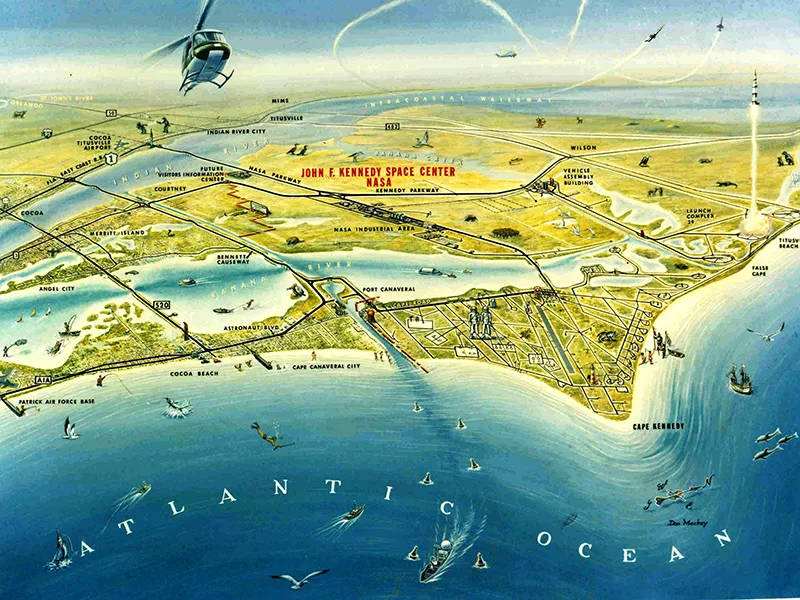
The early 1960s were a period of rapid growth for what is now NASA’s Kennedy Space Center (KSC). The United States was working hard to establish a presence in off-planet exploration, racing to secure a place in history. One big accomplishment came on May 5, 1961. Astronaut Alan Shepard made history as the first American in space. Only weeks later, President John F. Kennedy announced the goal to send humans to the Moon and back by the end of the decade. With word quickly spreading about NASA’s bold Mercury Program and the proposed ambitious next steps, growing numbers of press and public flocked to the Cape Canaveral area to get a closer look at America’s burgeoning space program. By 1963, visits to the area were becoming so popular that Texas Congressman Olin Teague, Chairman of the House Subcommittee on Manned Space Flight, asked NASA Administrator James Webb to create a visitor program that would build on public support and goodwill.
It all started as a drive-through tour of what was then known as Cape Kennedy, now called Cape Canaveral Space Force Station. On Sunday afternoons, the public could drive their own vehicles on a predetermined route that provided a glimpse of the launch pads and facilities. Despite the limited access, the tours proved immensely popular.
Começos humildes
Meanwhile, excitement began to build next door at Kennedy Space Center (KSC), which had earned its own status as an official space center in 1962 and had been named for the late President John F. Kennedy shortly after his assassination in November 1963. In January 1965, after a year of successful drive-through tours at Cape Kennedy, the tours expanded to include areas of the Kennedy Space Center. On the first day, nearly 2,000 visitors came. Based on this success, the Spaceflight Committee authorized $1.2 million for the creation of a visitor center at Kennedy Space Center.
With help from the National Park Service, NASA developed a plan to accommodate the projected 3.2 million visitors by 1970. The proposal included a Visitor Information Center (VIC) and a guided bus tour of the center and its operations, with a private concessioner contracted to operate these programs.
Solo sagrado
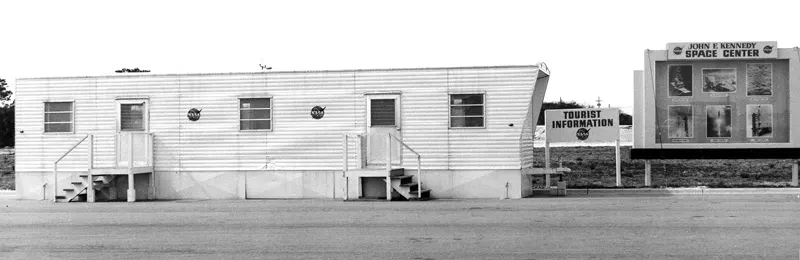
Several possible locations for the visitor center were discussed, but ultimately, a site within Kennedy Space Center was chosen because it provided virtually unlimited acreage for future expansion, and no matter what else visitors saw or did, they could say they had actually set foot on Kennedy Space Center.
Plans for the construction and content of the visitor center moved forward, and in the meantime, a temporary facility was established at the main entrance to the space center. It provided basic exhibits and restrooms and served as a hub for public bus tours, which began on July 22, 1966. Visitors could choose from two tours – a 1.5-hour tour of Kennedy Space Center or a 3-hour tour of Kennedy Space Center and Cape Kennedy Air Force Station. These new tours were offered seven days a week for a small operational fee. Within three months, nearly 100,000 visitors took the bus tour. Within one year, 475,000 guests toured KSC and the Cape, far exceeding NASA’s expectations.

Negócios movimentados
With visitation growing stronger each day, the new VIC was unveiled on August 1, 1967. It spanned 42 acres and featured examples of Mercury, Gemini, and Apollo hardware, as well as exhibits, two theaters, and concession and souvenir facilities housed within two main buildings.
As NASA grew closer to meeting its goal of landing a man on the Moon, visitation to Kennedy Space Center increased. Three days after the Apollo 8 crew orbited the Moon on Dec. 24, 1968, more than 10,000 visitors descended on the VIC, exceeding the buses’ capacity. Within 18 months, an expansion plan for the VIC was approved, including a new reception area and exhibit hall; a Hall of History with more exhibits, a theater, and classrooms; and other infrastructure improvements. By 1969, the visitor center had become one of the premier tourist destinations in Florida.
In the early 1970s, central Florida tourism was booming. In response to the growing popularity, the VIC invested in its exhibits and displays to better meet visitors’ expectations. Soon, about 1 million visitors a year explored interactive exhibits, walked among the giants in the Rocket Garden, and even rode a mock lunar rover. Notably, one of three Saturn V Moon rockets left in existence was put on display in the summer of 1976 as part of the U.S. Bicentennial Exposition on Science and Technology, held at KSC.
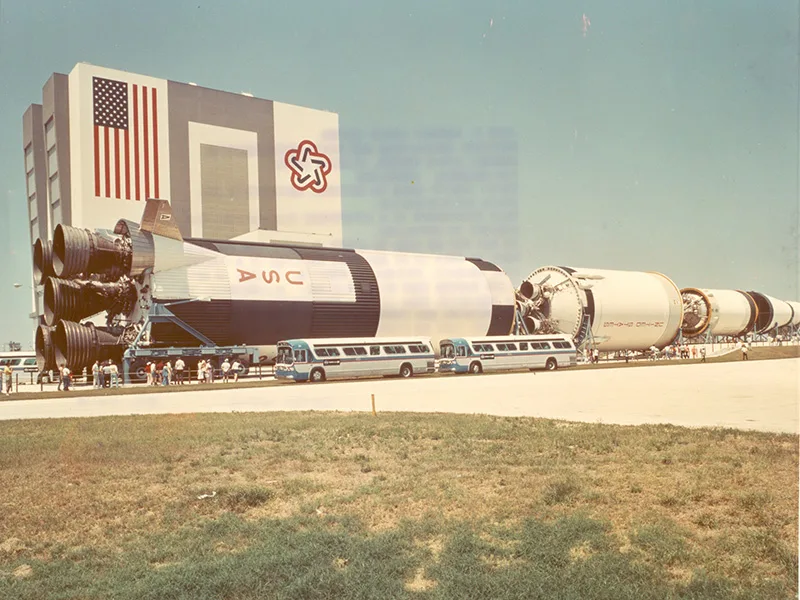
As the decade progressed, excitement was building around the new Space Shuttle Program. Visitors could learn about this upcoming program with expert-led presentations and unique displays. The success of the space shuttle gripped the first half of the 1980s, especially as the first American woman and first Black man ventured into space.
In 1991, a few years after the loss of space shuttle Challenger, the Space Mirror Memorial was dedicated. The black granite monument today is emblazoned with the names of each of the 25 astronauts who made the ultimate sacrifice, including the crews of Apollo 1, STS-51L/Challenger, and STS-107/Columbia, as well as other astronauts who died in jet and commercial plane crashes.

Uma nova direção
By 1995, with no government funds allocated to build new facilities and exhibits, the visitor center had become something of a hardware museum. While taxpayer funds had paid for the original NASA hardware, no additional funds had been allocated to maintain it. National artifacts and treasures such as the Apollo/Saturn V rocket lay outdoors, exposed to sun, rain, and salt that corroded and rusted it.
The same year, NASA awarded the contract for operations of its visitor center at KSC to a new concessioner, Delaware North, which still operates it to this day. Between 1995 and 2007, a combination of private investment and visitor-generated funds enabled numerous physical improvements to the facility, effectively rebuilding the visitor program. The “creature comforts” were the first aspects to be revamped, including restrooms, restaurants, buses, and retail shops. Plus, plans were already underway for the construction of the Apollo/Saturn V Center, which opened in January 1997. The opening of this attraction marked a first for NASA – it was the first time a major exhibit was opened within a restricted area, accessible to guests only through Kennedy Space Center tour buses. This attraction brought the priceless, 363-foot-long Saturn V Moon rocket indoors, away from the elements, and into a 100,000-square-foot facility featuring two dramatic theater presentations about the Apollo Program, countless other displays, and the Moon Rock Cafe. By this time, the visitor center had also undergone several name changes, including Spaceport USA and its current moniker, Kennedy Space Center Visitor Complex.
Check out more photos of the early days of Kennedy Space Center Visitor Complex, and stay tuned for the next installment of our history blog series: The History of the KSC Bus Tour.


