Kennedy Space Center Visitor Complex History: A 21st Century Attraction
Published: June 22 2026

This blog is part of the “History of Kennedy Space Center Visitor Complex” series.
In 2026, Kennedy Space Center Visitor Complex will celebrate the 60th anniversary of the bus tour. In honor of this milestone, we look back at where it all began and how the visitor complex has evolved over the years. Previously, we went back to the beginning to dive into the humble beginnings of the visitor complex. Now, we take a look at the rapid growth seen in the 21st century.
A 21st Century Attraction
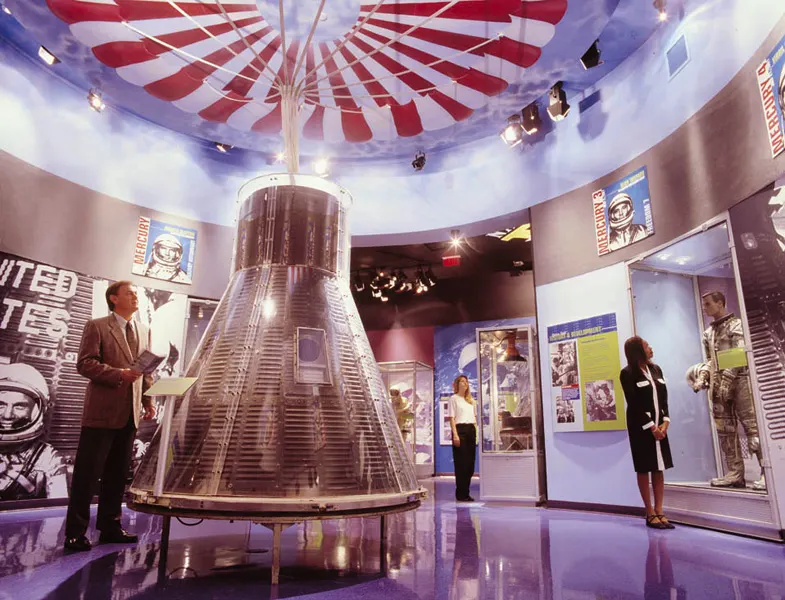
The years leading up to the new millennia brought many rapid changes to the Kennedy Space Center Visitor Complex that guests see today. From 1995 to 2000, several new exhibits and attractions were added, dramatically changing the landscape of the visitor complex. These changes included Nature & Technology, Early Space Exploration, the conference facility (known today as the Heroes and Legends Conference Facility), as well as a renovation of the Rocket Garden. New restaurants were also added during that period, including the Orbit Cafeteria. A second floor was added to The Space Shop, making it the world’s largest retail shop entirely devoted to space memorabilia and gifts. The Kennedy Space Center Bus Tour was further enhanced with two additional tour stops in 1998 – the Launch Complex-39 Observation Gantry and the International Space Station Center.
In 1999, the visitor complex set out to offer guests an even more historical perspective and a deeper look behind the scenes with the Cape Canaveral: Then and Now tour. This three-hour tour visited historic areas of the Cape Canaveral Air Force Station. Today, this tour is offered depending on the current Department of Defense guidance at Cape Canaveral Space Force Station.
As noted in the prior blog, government funds were no longer being allocated to maintain this visitor program. So, to ensure the ability to preserve and maintain the exhibits, the visitor complex implemented a gated admission policy in 2000. Whereas guests had previously paid only for the KSC bus tour and IMAX® movies, they would now pay a flat admission fee, which included the entire visitor complex experience, except for special interest tours, education programs, and Lunch With An Astronaut.

Astronauts Become Visitor Complex Regulars
Another major improvement to the visitor experience was the introduction of the Astronaut Encounter program in 2000, bringing a veteran NASA astronaut face-to-face with the public every day of the year. The 30-minute program, which is still offered today, features a brief introduction and presentation followed by a question-and-answer session with the astronaut. The first-of-its-kind interactive show features astronauts from the Mercury, Gemini, Apollo, Skylab, and Space Shuttle Programs, as well as those who have lived on the International Space Station.
As noted in the prior blog, government funds were no longer being allocated to maintain this visitor program. So, to ensure the ability to preserve and maintain the exhibits, the visitor complex implemented a gated admission policy in 2000. Whereas guests had previously paid only for the KSC bus tour and IMAX® movies, they would now pay a flat admission fee, which included the entire visitor complex experience, except for special interest tours, education programs, and Lunch With An Astronaut.
The Lunch With An Astronaut program provided guests a hot buffet meal during which the astronaut provides a more in-depth presentation of his or her experience, followed by a question-and-answer session and individual photos with guests. Today, the visitor complex offers a similar Chat With An Astronaut program as an add-on enhancement. This experience allows for a more personalized experience, with more time for questions and engaging conversations.
In 2000, the NASA Up Close tour was also added, which featured a stop and photo opportunity at the NASA Causeway alongside the scenic Banana River, and outside the Vehicle Assembly Building. This behind-the-scenes look at Kennedy Space Center operations has since been revamped as the KSC Explore Tour.

In September 2002, the United States Astronaut Hall of Fame® became part of the experience at Kennedy Space Center Visitor Complex. The attraction, located down the road, features the world’s most comprehensive collection of astronaut memorabilia ever assembled and honors all space explorers, particularly those who have been inducted into the Hall of Fame. This building also housed the Astronaut Training Experience® (ATX).
Our Space Shuttle Era
The year 2007 brought one of the visitor complex’s most exciting improvements to date — Shuttle Launch Experience® . Designed under the advisement of veteran NASA astronauts, this thrilling, highly realistic simulation of a space shuttle launch makes guests feel as if they are traveling at 17,500 mph on their way to orbit the Earth.

In April 2012, Kennedy Space Center Visitor Complex celebrated a remarkable milestone when it was entrusted with the care of the authentic space shuttle Atlantis: one of only three remaining space-flown orbiters in the world. In June 2013, the visitor complex unveiled Space Shuttle Atlantis® , including four cinematic productions and more than 60 interactive experiences that invite guests to “be the astronaut” and celebrate the people, passion, and patriotism behind the shuttle program.
Earlier in the same year, the visitor complex opened a dramatic new entry featuring a grand plaza and fountain, ticket booths and self-service kiosks, Will Call, guest services, and information booths. Additionally, in the entrance plaza, guests can enjoy taking photos in front of a 3D representation of the NASA insignia or “meatball” that spans 13 feet in diameter. To the right of the globe stood a majestic 75-foot-long fountain that pays homage to the dreams of late President John F. Kennedy. The fountain was replaced in 2023 with a 3D monument that takes guests through the highlights of our nation’s space program, with excerpts of Kennedy’s famous 1962 “Moon speech” at Rice University.
From 2013 to 2015, the visitor complex hosted rotating exhibits such as Angry Birds Space Encounter and Great Balls of Fire. The Orbit Cafeteria was remodeled and reopened as Orbit Cafe, and Journey to Space 3D was added to the IMAX Theater. The Early Space Exploration exhibit was closed in anticipation of remodeling and upgrades to include the relocated U.S. Astronaut Hall of Fame®. The exhibit morphed into Heroes & Legends featuring the U.S. Astronaut Hall of Fame and opened in 2016. The original U.S. Astronaut Hall of Fame facility, located six miles from the main visitor complex, continued to house the Astronaut Training Experience through the summer of 2017. The new ATX® Center, featuring Astronaut Training Experience and Mars Base 1, opened at the main visitor complex in the fall of 2017. Today, the ATX Center – Exploring with Lockheed Martin offers unique immersive simulators that are enjoyed by youth and adult groups alike, such as our popular frictionless microgravity experience.

A New Decade
The visitor complex soon turned its attention to the upcoming 50th anniversary of the Apollo Program Moon landings, beginning with Apollo 11’s anniversary in July 2019. The Apollo/Saturn V Center was updated to include a closer look at a real Lunar Module, updated interactive exhibits, and an all-new Moon Tree Garden with second-generation trees grown from seeds taken to the Moon and back. There were also a series of events and programs that celebrated the mission milestones, including special Apollo astronaut appearances and even a live Duran Duran concert in the Rocket Garden.
Seeking to inspire even more young explorers, Planet Play® opened in 2020. Outfitted from an IMAX theater, this multi-level play area allows kids to explore the planets, climb through wormholes, and try their hand at many space-themed activities and games. Not long after, the Rocket Garden welcomed a new rocket for the first time in decades, a United Launch Alliance Delta II rocket. At 128 feet (39 meters tall), it is now the tallest rocket (and youngest) space vehicle standing tall in the garden.

In June of 2022, Delta II got a new neighbor, Gateway: The Deep Space Launch Complex®. Envisioned to share the “now and next” of NASA and its commercial partners, Gateway was designed to be a fascinating, rotating exhibit hall that showcases prototypes of the future of space travel from an expanding space center. Suspended from the ceiling is a real SpaceX Falcon Heavy booster that helped deliver a Tesla Roadster into space. Gateway is also home to the visitor complex’s most immersive simulator yet: Spaceport KSC®. Imagined as a spaceport of the future, guests can choose their own mission and “launch” to distant parts of our galaxy before returning safely back to Earth.
For the first time since the Space Shuttle Program ended, a tour stop was added to the Kennedy Space Center Bus Tour. The LC-39 Observation Gantry was renovated, updated, and reopened in 2025. Focusing on rocket sciences and NASA’s symbiotic relationship with the Merritt Island National Wildlife Refuge on which Kennedy Space Center stands, The Gantry at LC-39 offers panoramic views of active launch pads, including the adjacent Launch Complex 39 and the numerous pads seen at Cape Canaveral Space Force Station. It also still serves as a premium launch viewing site for launches occurring at Cape Canaveral.
New experiences are on the horizon for the visitor complex. Just as NASA continues to grow, expand, and evolve, so too will its premier visitor center – Kennedy Space Center Visitor Complex.
Stay tuned for a more comprehensive history of the attraction that started it all: the Kennedy Space Center Bus Tour.