The History of the Kennedy Space Center Bus Tour
Published: July 22 2026

July 2026 marks the 60th anniversary of the Kennedy Space Center Visitor Complex bus tour—the origin of the visitor experience as we know it today. Revisit the tour’s humble beginnings and explore how it has evolved over the years, alongside America’s space program.
Paving the Road: The Beginning of the Bus Tours
In the early 1960s, growing public fascination with the United States’ space program drew thousands to Cape Canaveral. As rocket launches captured national attention, visitors began traveling to Florida’s Space Coast in unprecedented numbers, eager to catch a glimpse of the source of this new frontier. By 1963, visits to the area were becoming so popular that a visitors program was started, beginning as a drive-through tour of what was then known as Cape Kennedy, now called Cape Canaveral Space Force Station. On Sunday afternoons from 1:00 – 4:00 PM, the public was invited to drive their own vehicles on a predetermined tour route that provided a glimpse of the launch pads and facilities.
Despite the limited access, the tours proved immensely popular. From late 1963 to late 1964, an estimated 100,000 visitors took advantage of the chance to tour the Cape. With help from the National Park Service, NASA proposed a Visitor Information Center (VIC), as well as a guided bus tour of the center and its operations. While plans for this permanent visitors center were underway, NASA conducted bus tours at a temporary facility at the entrance of Kennedy Space Center.
From that temporary facility, the first bus tours began. The first guided bus tour embarked on July 22, 1966. Visitors could choose from two tours – a 1.5-hour tour of Kennedy Space Center or a 3-hour tour of Kennedy Space Center and Cape Kennedy Air Force Station. The new tours were offered seven days a week at regular intervals, and a small fee helped recover the cost of operating the 10 rented tour buses.
During the first week of operation, a reported 13,555 guests took the guided bus tour, with 75% opting for the 3-hour tour that provided a look at both KSC and the Cape. Within three months, nearly 100,000 visitors took the bus tour. Within one year, 475,000 guests toured KSC and the Cape— far exceeding NASA’s expectations.

Booming Business
With visitation growing stronger each day, the new VIC was unveiled on August 1, 1967. It spanned 42 acres and featured examples of Mercury, Gemini, and Apollo hardware, as well as exhibits, two theaters, and concession and souvenir facilities housed within two main buildings.
As NASA grew closer to meeting its goal of landing a man on the Moon, visitation to Kennedy Space Center increased. Three days after the Apollo 8 crew orbited the Moon on Dec. 24, 1968, more than 10,000 visitors descended on the VIC, exceeding the buses’ capacity. Within 18 months, an expansion plan for the VIC was approved, including a new reception area and exhibit hall, and other infrastructure improvements. By 1969, the visitor center had become one of the premier tourist destinations in Florida.
In the early 1970s, central Florida tourism was booming. In response to the growing popularity, the VIC invested in its exhibits and displays to better meet visitors’ expectations. Soon, about 1 million visitors a year explored interactive exhibits, walked among the giants in the Rocket Garden, and even rode a mock lunar rover. Notably, one of three Saturn V Moon Rockets left in existence was put on display in the summer of 1976 as part of the U.S. Bicentennial Exposition on Science and Technology, held at KSC, and bus tours took guests to view the rocket in front of the Vehicle Assembly Building.
The New Millenia
Jump forward a bit and by the late 1990s, the visitor complex began offering additional tour stops and extended the bus tours to give guests a closer, more in-depth look at scenic and operational sites of the space center. The Saturn V Moon rocket was moved indoors with the opening of the Apollo/Saturn V Center, only accessible via the bus tour. In 1998, two stops were added in addition to the Apollo/Saturn V Center: the Launch Complex-39 Observation Gantry, a panoramic photo stop with a view of space shuttle launch pads, as well as presentations and exhibits explaining the launch process, and the International Space Station Center, offering guests a behind-the-scenes look at actual components of the station being assembled prior to their launch and installation.
However, in 1999, the visitor complex set out to offer guests an even more historical perspective and a deeper look behind the scenes with the Cape Canaveral: Then and Now tour. This extensive, three-hour guided bus tour transported guests to historic areas of the Cape Canaveral Air Force Station, including the U.S. Air Force Space and Missile Museum; Blockhouse 5/6, the actual Mercury Mission Control Center and the site of Alan Shepard’s historic launch; and Launch Complex 34, the site of the Apollo 1 tragedy that took the lives of three brave astronauts.
In 2000, the NASA Up Close tour was added. This behind-the-scenes look at Kennedy Space Center operations features a stop and photo opportunity at the NASA Causeway alongside the scenic Banana River, and outside the Vehicle Assembly Building. A final photo stop at a camera bunker near Launch Complex 39 provides a panoramic shot of launch pads 39A & B. Guests on this tour also drove by the Launch Control Center, the NASA Press Site, the countdown clock, as well as Kennedy Space Center Headquarters, among many other sites.
Today, the KSC Explore Tour, similar to the NASA Up Close Tour, still operates multiple times a day and remains a very popular add-on enhancement. All Cape Canaveral tours operate depending on current Department of Defense guidance at Cape Canaveral Space Force Station.
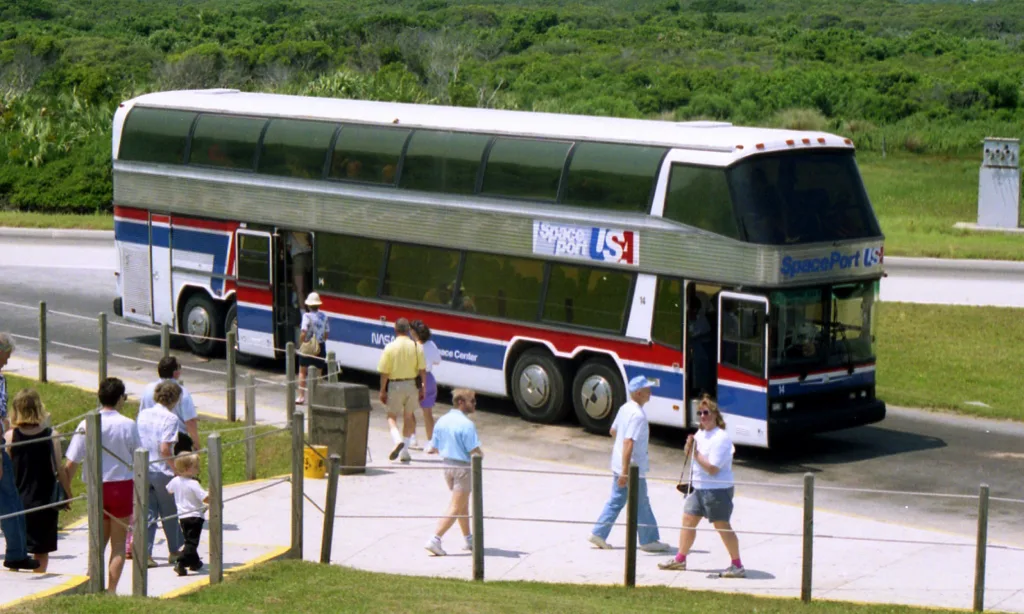
A Post-Shuttle Era at Kennedy Space Center
When the Space Shuttle Program ended and the International Space Station was complete, the LC-39 Observation Gantry and International Space Station Center stops were removed from the bus tour. Yet, the visitor complex was able to offer the KSC Up-Close Launch Control Center Tour beginning in 2012, offering visitors an insider’s look at Kennedy Space Center’s Firing Room #4, where the last 21 space shuttle missions were launched, as well as a drive past Launch Complex 39 and a photo stop nearby. This tour concluded in 2017 as NASA began using the Launch Control Center more frequently in preparation for future Artemis Program missions.
For the first time since the Space Shuttle Program ended, a tour stop was added back to the Kennedy Space Center Bus Tour that is included with admission. The LC-39 Observation Gantry was renovated, updated, and re-opened in 2025 as The Gantry at LC-39. Focusing on rocket science and NASA’s symbiotic relationship with the Merritt Island National Wildlife Refuge on which Kennedy Space Center stands, The Gantry at LC-39 offers panoramic views of active launch pads, including the adjacent Launch Complex 39 and the numerous pads seen at Cape Canaveral Space Force Station. It continues to serve as a premium launch viewing site for launches occurring at Cape Canaveral.
Historic Images of the Kennedy Space Center Bus Tour


Now in 2026, 60 years after the start of the guided bus tours, the number one question we still hear is “where is the bus tour?” Telling the NASA story has been our mission since day one, and the bus tour continues to be a top experience at Kennedy Space Center Visitor Complex. Our goal has remained the same all these years: to educate and inspire the public on the work that is being done here at America’s premier spaceport.
Plan your visit and be sure to take the Kennedy Space Center Bus Tour. Even after 60 years of tours, you never know what you may see outside your window when touring behind NASA’s gates.